HVAC Services
Schedule Heating and HVAC Services in Chicago
A walk-in cooler that won’t stay cold can become a serious problem for any restaurant, grocery store, deli, or commercial kitchen. You might notice the temperature climbing during busy hours, discover that products feel warmer than expected, or arrive in the morning to find the cooler several degrees above its usual setting.
Sometimes the cooler appears to be running normally. The fans are moving, the lights are working, and the compressor may still be operating. But the temperature continues to rise.
If your walk-in cooler is not holding temperature, the problem may involve restricted airflow, dirty condenser coils, damaged door gaskets, evaporator icing, faulty temperature controls, or a refrigeration system malfunction. The most important first step is to verify the actual temperature of the food, protect temperature-sensitive inventory, and determine whether the equipment is cooling properly.
This guide explains what temperatures commercial coolers should maintain, why cooling problems happen, what business owners can safely check, and when a professional refrigeration technician is needed.
By Chicago HVAC King | Commercial HVAC & Refrigeration | Updated October 14, 2026
What Temperature Should a Walk-In Cooler Maintain?
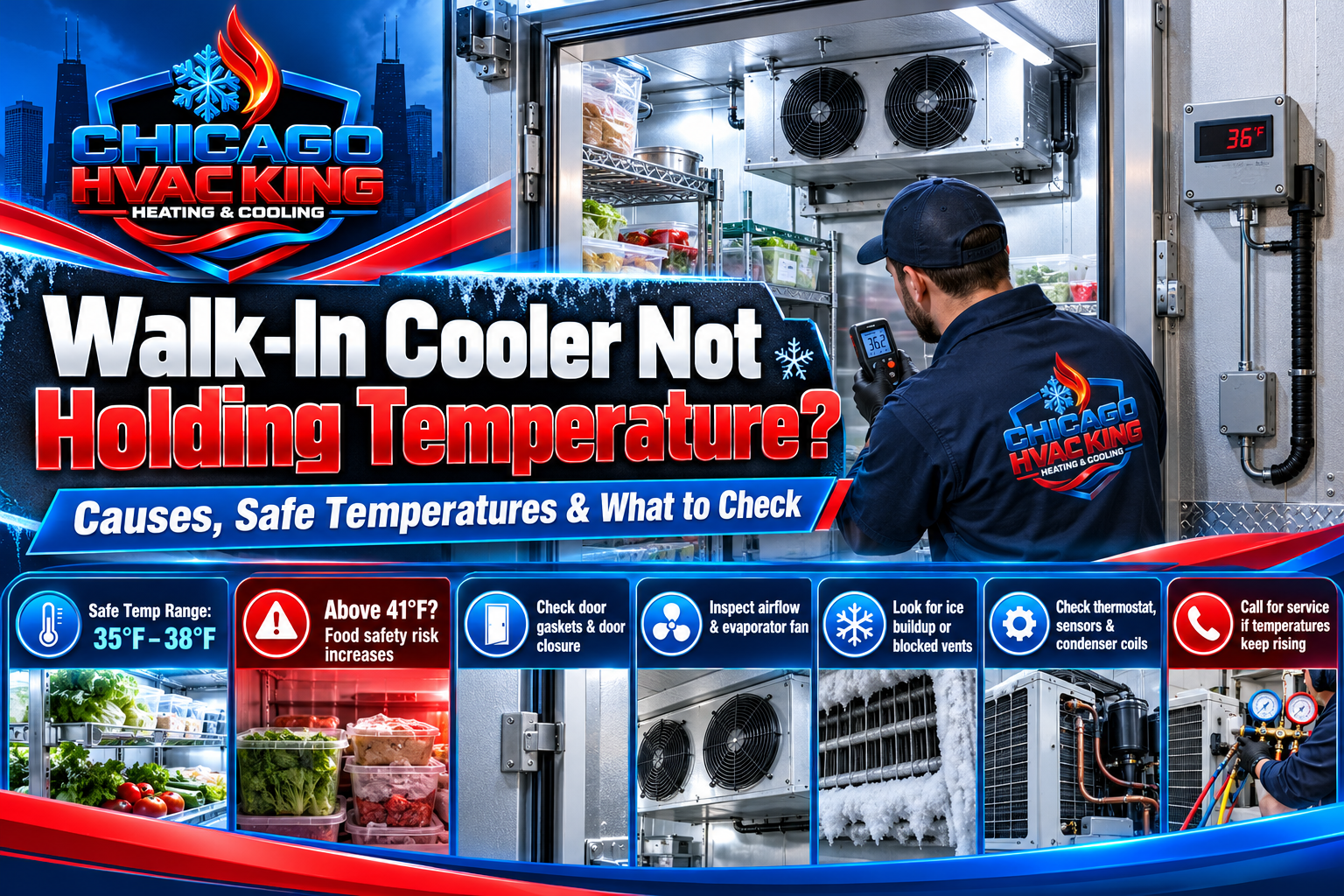
Most commercial walk-in coolers used for refrigerated food storage operate with air temperatures around 35°F to 38°F, although the appropriate setting depends on the equipment, products, and operating conditions.
The FDA Food Code generally requires foods classified as time/temperature control for safety (TCS) to be cold-held at 41°F (5°C) or below, with certain exceptions. Some foods or products may require different temperatures under specific regulations or manufacturer instructions.
For a typical restaurant storing meat, dairy products, prepared ingredients, and other refrigerated foods, keeping the cooler’s air temperature below that food-safety limit provides a useful margin for normal fluctuations.
However, the temperature displayed on the cooler’s controller is not necessarily the same as the temperature of the food stored inside.
Walk-In Cooler Temperature Reference
| Temperature | What It May Indicate |
|---|---|
| 35–38°F | Common target air-temperature range for many food-service walk-ins |
| 39–40°F | Less margin for door openings and normal temperature fluctuations |
| 41°F | General maximum cold-holding temperature for many TCS foods |
| 42–45°F | Investigate promptly; verify actual food temperatures |
| Above 45°F | Significant concern requiring immediate attention to equipment and food safety |
These temperatures are general reference points, not a universal operating specification for every commercial cooler.
Important: A cooler air reading above 41°F does not automatically prove every product is unsafe, just as a display reading below 41°F does not prove every product is safe. Food temperatures, exposure duration, product type, and applicable food-safety rules determine the appropriate response.
Restaurant operators should use calibrated food thermometers, maintain temperature records, and follow local health department requirements and their food safety procedures.
Why Is My Walk-In Cooler Running but Not Getting Cold?
One of the most confusing refrigeration problems occurs when a walk-in cooler seems to operate continuously but cannot reach its target temperature.
Several different mechanical problems can produce this symptom.
1. Dirty Condenser Coils
A refrigeration system removes heat from inside the cooler and transfers it to another location through the condenser.
When condenser coils become covered in dust, grease, or debris, the equipment may struggle to release heat efficiently.
This can cause higher operating temperatures, longer compressor cycles, and additional stress on refrigeration components.
Restaurants and commercial kitchens can be particularly demanding environments because airborne grease and dust may accumulate around refrigeration equipment.
A condenser cleaning may help when dirt is the primary problem, but persistent high temperatures require further evaluation.
2. Refrigerant Leaks or Refrigeration Circuit Problems
Refrigerant circulates through the refrigeration system and transfers heat away from the cooler.
If the system develops a refrigerant leak, cooling capacity may decrease.
Possible symptoms include:
- The cooler takes much longer to reach its set temperature.
- The compressor runs for extended periods.
- The unit no longer recovers quickly after door openings.
- Ice develops in unusual locations.
- Cooling performance continues declining over time.
However, none of these symptoms proves that refrigerant is leaking. Similar issues can result from airflow restrictions, controls, or mechanical failures.
Refrigerant should not simply be added without determining why the system is underperforming. Leak testing and refrigerant-circuit repairs should be completed by appropriately certified refrigeration professionals.
3. Evaporator Fan Problems
Evaporator fans circulate air through the cooling coil and around the storage area.
When a fan stops running, runs slowly, or becomes obstructed, the cooler may develop uneven temperatures.
For example, products near one wall may remain cold while items on another shelf become noticeably warmer.
Depending on the equipment, fan problems can involve electrical components, motors, wiring, controls, or ice restricting the fan blades.
4. Ice Buildup on the Evaporator Coil
An evaporator coil covered in ice may be unable to transfer heat effectively.
As frost accumulates, airflow through the coil can decrease, preventing the equipment from cooling the space properly.
Possible causes include excessive moisture entering through doors, restricted airflow, control problems, or other refrigeration system faults.
The correct repair depends on why the coil is icing up.
5. Faulty Temperature Sensors or Controls
Commercial refrigeration equipment uses temperature sensors, thermostats, and controllers to regulate operation.
A faulty sensor may report an inaccurate temperature. Control problems may also interfere with compressor operation, fan cycling, or defrost functions.
If a displayed temperature seems inconsistent with an independently measured temperature, the controls deserve further evaluation.
The display alone should not be used to determine whether stored food is safe.
6. Compressor or Electrical Problems
The compressor is a major component of the refrigeration system.
Starting problems, electrical faults, damaged components, and mechanical wear may prevent the system from providing sufficient cooling.
A compressor problem should not be assumed simply because the cooler is warm.
Professional testing can help distinguish compressor failure from electrical, control, and other refrigeration problems.
Why Does My Walk-In Cooler Temperature Rise During the Day?
A walk-in cooler that maintains temperature overnight but becomes warmer during business hours may be experiencing additional heat and moisture entering the storage area.
This is particularly common in busy restaurants and commercial kitchens.
Frequent Door Openings
Every time the door opens, warm surrounding air can enter the refrigerated space.
During a busy lunch or dinner service, employees may repeatedly enter the cooler to retrieve ingredients.
If the door remains open for extended periods, the refrigeration system must remove additional heat to restore normal conditions.
Short temperature fluctuations may be expected, but the system should recover appropriately.
Damaged Door Gaskets
A worn or torn door gasket can allow warm air to enter even when the door appears closed.
This may increase cooling demand, moisture buildup, and frost formation.
Inspect visible gaskets for cracks, gaps, missing sections, or areas where the door does not seal properly.
Worn Door Closers or Misaligned Doors
If the cooler door does not close completely, warm air can continuously enter the storage space.
Problems may involve door hinges, closers, alignment, hardware, or damaged seals.
A door that must be pushed or lifted to latch correctly should be inspected.
High Kitchen Temperatures
Commercial kitchens can become extremely warm during operating hours.
If refrigeration condensers are located in poorly ventilated mechanical spaces or near heat-producing equipment, higher surrounding temperatures may affect condenser performance.
The solution may involve correcting ventilation, condenser maintenance, or evaluating the equipment’s operating conditions.
Loading Large Amounts of Warm Product
A walk-in cooler is primarily intended to maintain refrigerated products at safe temperatures.
Placing large quantities of warm food into the cooler adds substantial heat.
Commercial kitchens must follow applicable procedures for rapidly cooling cooked food. A standard walk-in cooler may not have the capacity to cool large volumes of hot food safely without appropriate preparation methods or specialized equipment.
What this means: If your walk-in cooler works overnight but struggles during business hours, the problem may involve doors, usage patterns, product loading, equipment capacity, or a mechanical issue that becomes noticeable under heavier demand.
What to Check First When a Walk-In Cooler Is Too Warm
Before requesting repairs, there are several observations business owners can make safely without opening electrical panels or working on refrigeration components.
Check 1: Verify the Temperature
Use a reliable independent thermometer to confirm the cooler’s air temperature.
For food-safety decisions, check representative food temperatures with a properly calibrated thermometer according to your food safety procedures.
Do not assume the digital display is accurate.
Check 2: Inspect the Door
Make sure the door closes and seals correctly.
Look for visible gasket damage, objects blocking the doorway, or hardware preventing a complete seal.
Check 3: Look for Blocked Airflow
Check whether boxes, containers, or stored products are blocking air circulation around the evaporator or other required clearances.
Follow the equipment manufacturer’s storage and clearance recommendations.
Check 4: Observe Ice or Frost
Look for excessive frost on visible accessible surfaces.
Heavy ice buildup may indicate a defrost issue, moisture infiltration, or another mechanical problem.
Do not chip ice from coils with sharp tools or use uncontrolled heating methods.
Check 5: Listen for Unusual Sounds
Take note of new rattling, grinding, buzzing, repeated clicking, or unexpected periods of silence.
These observations may help a technician identify the affected components.
Check 6: Check for Visible Water
Water collecting on the cooler floor or around equipment can indicate drainage problems, excessive condensation, or other malfunctions.
Avoid contact with electrical equipment near standing water.
Check 7: Review Temperature Records
If your business maintains temperature logs, compare recent readings with normal operating patterns.
A gradual increase over several days may help distinguish a developing problem from an isolated temperature fluctuation.
Do not attempt electrical repairs, open refrigerant lines, bypass safety controls, or disassemble refrigeration equipment without the necessary qualifications.
Walk-In Cooler Temperature Problem Troubleshooting Chart
The following table helps business owners recognize common symptoms. It does not replace equipment diagnosis.
| What You Notice | Possible Causes | Recommended Next Step |
|---|---|---|
| Cooler running constantly but warm | Dirty condenser, inadequate capacity, refrigerant issue, control problem | Arrange refrigeration diagnosis |
| Heavy ice on evaporator | Defrost fault, airflow restriction, excessive moisture | Request an equipment inspection |
| Temperature rises during busy hours | Frequent door openings, gasket damage, high heat load | Check door operation and usage patterns |
| Some shelves warmer than others | Poor air circulation, blocked airflow, fan problem | Check storage placement; arrange service if persistent |
| Cooler warm but display appears normal | Sensor or display issue, uneven temperatures | Verify readings independently |
| Water on cooler floor | Drain obstruction, condensation, ice melt | Locate visible moisture and request service |
| Compressor repeatedly starts and stops | Controls, electrical or refrigeration fault | Stop troubleshooting and request professional evaluation |
| Cooler does not recover after closing | Mechanical fault, excessive heat load, door leakage | Arrange refrigeration service |
A useful detail to record is how quickly the cooler temperature recovers after the door has remained closed.
The appropriate recovery time varies by equipment and conditions, but an unusually slow recovery can help indicate that the system is struggling to remove heat.
Why Does a Walk-In Cooler Get Warm Overnight?
When a walk-in cooler is warm in the morning but appeared to operate normally the previous evening, business owners often suspect that the compressor stopped working.
That is one possibility, but not the only explanation.
Automatic Defrost Problems
Some refrigeration systems use timed or demand-based defrost operations.
If the defrost controls malfunction, equipment may remain in an inappropriate operating state or fail to return to normal cooling.
The exact behavior depends on system design.
Intermittent Electrical or Control Failures
Loose connections, failing contactors, defective controls, or other electrical problems may cause intermittent shutdowns.
A unit can appear normal when inspected during the day but fail again later.
Compressor Overheating or Protective Shutdowns
Some equipment includes protective devices that shut down components under abnormal conditions.
The system may restart after cooling down, making the original failure difficult to identify without testing.
Doors Left Open
An improperly closed door can allow warm, humid air to enter throughout the night.
This may cause temperatures to rise and ice to accumulate.
Failed Fans
A fan that operates intermittently may create temperature instability, particularly during longer unattended periods.
If the cooler is warm when staff arrive, treat the stored inventory as a potential food-safety concern until temperatures and exposure history have been evaluated.
Do not assume that closing the door and waiting for the cooler to return to its set temperature makes food that has been improperly stored safe again.
Can a Walk-In Cooler Still Be Used If It’s Above 41°F?
This is an important question for restaurants and food-service businesses.
A walk-in cooler displaying an air temperature above 41°F requires prompt investigation, but food safety cannot be determined from that air reading alone.
Under the FDA Food Code, most TCS foods must be maintained at 41°F or below during cold holding, subject to applicable exceptions.
Different products, exposure histories, and approved time-as-a-public-health-control procedures may affect the appropriate handling requirements.
If your walk-in cooler becomes too warm:
- Check actual food temperatures using a calibrated food thermometer.
- Review available temperature records to establish when the problem may have started.
- Stop placing additional temperature-sensitive inventory into malfunctioning equipment.
- Transfer suitable products to verified working refrigeration when this can be done safely and according to your food safety plan.
- Follow applicable health department guidance for evaluating, holding, or discarding products.
- Arrange refrigeration service to address the equipment problem.
Do not taste food to decide whether it is safe.
Food can contain harmful microorganisms without developing an unusual odor, appearance, or taste.
The USDA’s household refrigerator guidance commonly discusses a 40°F target. Commercial food-service operations should follow their applicable regulatory requirements, which may differ from general household guidance.
Protecting food safety comes before protecting inventory value.
Why Does My Walk-In Cooler Keep Icing Up?
Ice inside a walk-in cooler can appear around the evaporator, near doors, on ceilings, or along other surfaces.
The location and pattern of the ice can provide useful clues about the problem.
Ice Around the Evaporator
Frost accumulating on the evaporator may indicate airflow restrictions, excessive moisture, defrost problems, or a refrigeration fault.
When ice restricts airflow, cooling performance can decline.
Ice Near the Door
Ice or heavy condensation around the doorway may result from damaged gaskets, improperly closing doors, or excess warm, humid air entering the cooler.
Ice That Returns After Melting
If ice repeatedly returns, removing it only addresses the symptom.
The underlying reason for frost formation still needs to be identified.
Is It Safe to Melt the Ice Yourself?
Avoid using knives, screwdrivers, torches, heat guns, or other improvised methods to remove ice from refrigeration components.
These methods can damage coils, refrigerant lines, wiring, and insulation.
If excessive icing is preventing normal operation, arrange an inspection rather than repeatedly removing ice without diagnosing the cause.
Chicago HVAC King provides commercial refrigeration repair for problems involving cooling performance, defrost components, and related refrigeration equipment.
What Happens During a Professional Walk-In Cooler Inspection?
A technician’s approach depends on the reported problem and equipment design.
An inspection may begin by reviewing the current temperature, the controller settings, equipment operating history, and visible system condition.
Depending on the symptoms, professional testing may involve:
- Checking thermostat and sensor readings
- Evaluating condenser and evaporator operation
- Inspecting electrical controls and connections
- Checking fan motor operation
- Assessing refrigerant system performance
- Examining defrost controls and components
- Checking door seals and air infiltration
- Evaluating drainage and condensation
- Reviewing equipment operating conditions
A temperature problem can sometimes involve multiple contributing factors.
For example, a cooler may have a dirty condenser and a damaged door gasket. Repairing only one issue may improve performance without completely resolving the problem.
A proper diagnosis helps determine which repairs are necessary and whether the equipment has additional operating concerns.
The technician should be able to explain the findings, recommended repairs, and any limitations affecting the system.
When Should You Repair or Replace a Walk-In Cooler?
A walk-in cooler is a collection of components rather than one single piece of equipment.
The insulated enclosure, doors, evaporator, condenser, compressor, controls, and refrigeration components may have different service lives.
Because of this, a major refrigeration failure does not always mean the entire walk-in enclosure needs replacement.
Repair May Make Sense When:
- The enclosure and insulation remain in good condition.
- The refrigeration equipment is otherwise reliable.
- Replacement components are available.
- The problem is limited to specific parts.
- The repair cost is reasonable compared with equipment replacement.
Replacement May Be Worth Considering When:
- The refrigeration system experiences repeated major failures.
- Replacement parts are difficult to obtain.
- The existing equipment no longer meets operational needs.
- Insulation or enclosure components have significant deterioration.
- The cost of major repairs approaches the cost of a suitable replacement.
- Equipment performance remains unreliable after previous repairs.
Can You Replace Only the Refrigeration System?
In some situations, businesses can replace the condensing unit, evaporator, or other refrigeration components while retaining an existing walk-in enclosure.
Compatibility, system capacity, refrigerant requirements, controls, and installation conditions must be evaluated before choosing this approach.
This is one reason professional assessment is important before replacing an entire cooler.
How to Help Prevent Walk-In Cooler Temperature Problems
Preventive maintenance is one of the most practical ways to reduce avoidable refrigeration issues.
Although no maintenance program eliminates every breakdown, routine inspections and good operating practices can help identify problems earlier.
Keep Condenser Areas Clean
Follow the equipment manufacturer’s maintenance instructions for condenser cleaning and accessible equipment areas.
Dust, grease, and restricted ventilation can make heat rejection more difficult.
Inspect Door Gaskets
Look regularly for damaged or worn seals.
Make sure doors close properly and employees are not leaving them open unnecessarily.
Maintain Proper Storage Clearances
Avoid stacking boxes or products against evaporator airflow paths.
Follow manufacturer requirements for air circulation and loading.
Monitor Temperatures
Use independent thermometers and maintain appropriate food temperature records.
Some businesses may benefit from temperature-monitoring systems that alert staff when equipment moves outside established operating limits.
Pay Attention to Changes in Equipment Behavior
Longer operating cycles, new sounds, unexplained frost accumulation, or declining temperature recovery should not be ignored.
Schedule Equipment Inspections
Periodic refrigeration inspections may help identify worn components, airflow restrictions, and other developing issues.
The appropriate maintenance frequency depends on equipment design, usage, operating environment, and manufacturer recommendations.
For a busy restaurant, maintaining a record of equipment service and recurring problems can make future troubleshooting more efficient.
Frequently Asked Questions About Walk-In Cooler Temperatures
Why is my walk-in cooler not getting below 45°F?
Possible causes include dirty condenser coils, malfunctioning fans, refrigerant system problems, faulty controls, inadequate equipment capacity, or warm air entering through poorly sealed doors. A cooler that cannot maintain the required temperature should be evaluated promptly, and the actual temperature of stored food should be verified.
Is 40°F too warm for a walk-in cooler?
A 40°F air reading may be within the operating range of some refrigeration equipment, but it provides less margin for temperature fluctuations than a lower setting. Many commercial kitchens target approximately 35°F to 38°F for refrigerated storage. Always follow equipment, product, and applicable food-safety requirements.
Why does my walk-in cooler temperature keep fluctuating?
Temperature fluctuations may result from door openings, automatic defrost cycles, changing product loads, airflow restrictions, faulty sensors, or mechanical problems. Small air-temperature variations can occur during normal operation, but persistent or excessive changes require investigation.
Why is the compressor running but the cooler is warm?
The system may be unable to remove heat effectively because of condenser problems, refrigerant circuit faults, inadequate airflow, or other mechanical issues. Compressor noise alone does not confirm that refrigeration is operating correctly.
Can dirty condenser coils cause a walk-in cooler to stop cooling?
Yes. Heavy dirt and grease accumulation can reduce the condenser’s ability to release heat, affecting refrigeration performance. Cleaning may help when dirt is the primary issue, but persistent cooling problems require diagnosis.
Why does my walk-in cooler work at night but not during the day?
Frequent door openings, product loading, higher kitchen temperatures, and heavier operating demands may contribute. The system might also have an underlying mechanical problem that becomes more noticeable during busy hours.
How long should a walk-in cooler take to reach its temperature?
There is no universal recovery time. It depends on the size and design of the system, current temperature, surrounding conditions, product load, and the amount of heat that must be removed. Unusually slow recovery should be evaluated against normal equipment performance.
Should I turn off a walk-in cooler if it is icing up?
The appropriate action depends on the equipment condition and severity of the problem. Do not attempt unsafe defrosting methods or electrical repairs. If icing is affecting performance, follow manufacturer instructions and arrange professional service. Ensure temperature-sensitive products are protected.
Can I add refrigerant to make the cooler colder?
Refrigerant should not be added without an appropriate diagnosis. Low refrigerant charge may indicate a leak or another condition requiring repair. Refrigerant handling should be performed by properly certified professionals.
Who should I call when my restaurant walk-in cooler stops cooling?
Contact a commercial refrigeration service provider that works with walk-in coolers and freezers. Provide the equipment information, current temperature, symptoms, and how long the problem has been occurring.
Need Help With a Walk-In Cooler That Won’t Stay Cold?
A walk-in cooler that isn’t maintaining temperature can affect your inventory, food storage, and daily business operations.
Chicago HVAC King provides commercial refrigeration troubleshooting and repair services for restaurants, grocery stores, commercial kitchens, and other businesses throughout Chicago and surrounding suburbs.
Whether your cooler is running constantly, developing excessive ice, or struggling to maintain a consistent temperature, our team can help identify the problem and discuss the appropriate repair options.
Call (708) 412-0736
Request Commercial Refrigeration Service
Learn more about our Walk-In Cooler Repair Services or explore our Commercial HVAC & Refrigeration Services.
Chicago HVAC King
Commercial HVAC & Refrigeration Services
Chicago, IL | Serving Chicago and surrounding suburbs
Phone: (708) 412-0736