HVAC Services
Schedule Heating and HVAC Services in Chicago
By Chicago HVAC King | October 27, 2026
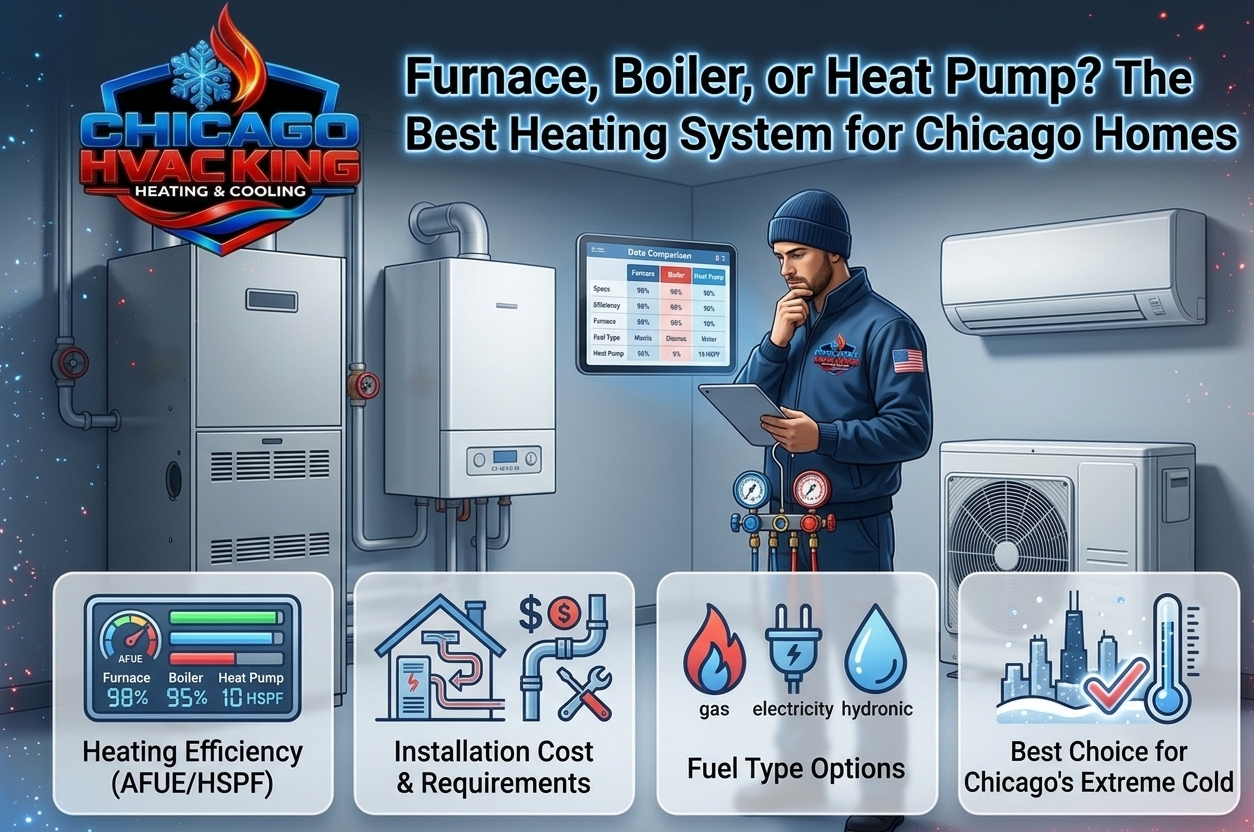
The best heating system for Chicago is the one that keeps your home warm on a below-zero night without wrecking your gas or electric bill. For most homes, that comes down to three choices: a gas furnace, a boiler, or a heat pump.
Each one works. But they don’t work the same way, they don’t cost the same, and they don’t fit every home. A brick bungalow with ductwork is a different job than a greystone two-flat with radiators.
This guide explains how each system handles Chicago cold, what each one costs, and which one makes sense for your home. We provide emergency heating repair in Chicago.
The Quick Answer
- Gas furnace: The most common pick for Chicago homes with ductwork. Strong heat in any weather, and gas is cheaper this winter.
- Boiler: The right fit for homes and buildings with radiators. Even, quiet heat. Common in older Chicago two-flats, greystones, and apartment buildings.
- Heat pump: Heats and cools with one system. Newer cold-climate models work in Chicago, but most homes here still need backup heat for the coldest nights.
- Heat pump plus furnace (dual fuel): A popular middle ground. The heat pump handles mild days, and the furnace takes over when it gets really cold.
What Chicago Cold Asks of a Heating System
Chicago winters are long, and the worst nights are brutal.
HVAC pros size heating systems here for about 5 below zero. That’s the industry design temperature for Chicago: the cold a system has to handle on the worst nights of a normal winter.
Some winters go well past that. On January 30, 2019, O’Hare hit 23 below, and the city stayed below zero for 52 hours straight.
So any heating system in Chicago has to do two things:
- Run for months without a break
- Keep up when it’s below zero for days
Furnaces and boilers burn gas, so cold outdoor air doesn’t change how much heat they make. Heat pumps are different, and that’s where most of the questions come from.
How Each System Heats Your Home
Gas Furnace
A furnace burns natural gas and blows warm air through ducts and vents. Most Chicago homes with central air already have the ducts, so the furnace and AC share them.
Boiler
A boiler heats water. Hot water or steam travels through pipes to radiators or baseboards in each room. There are no ducts and no blowing air. A U.S. Department of Energy study notes that Chicago’s older apartment buildings are mostly heated by steam or hot water systems.
Heat Pump
A heat pump runs on electricity. It doesn’t burn anything. It pulls heat out of the outdoor air and moves it inside. In summer, it runs in reverse and works like an air conditioner.
Even at 5 degrees, there’s still heat in the outdoor air to grab. But the colder it gets, the harder a heat pump has to work, and the less heat it can put out.
Furnace vs. Boiler vs. Heat Pump: Side by Side
| Gas Furnace | Boiler | Heat Pump | |
|---|---|---|---|
| How it heats | Burns gas, blows warm air through ducts | Heats water or steam, sends it to radiators | Moves heat from outdoor air using electricity |
| Below-zero performance | Full heat in any weather | Full heat in any weather | Loses power as it gets colder; usually needs backup heat |
| Cooling | No (pairs with central AC) | No | Yes, heats and cools |
| Needs ductwork | Yes | No | Ducted models yes, mini-splits no |
| Comfort | Fast heat, can feel drafty or dry | Even, quiet, steady heat | Steady, gentle heat |
| Upfront cost | $$ | to $ | to $ |
| Running cost this winter | Low (gas prices down) | Low to medium | Medium (electric prices up) |
| Typical lifespan | 15 to 20 years | 15 to 20+ years | 10 to 15 years |
| Best fit in Chicago | Homes with ducts | Homes with radiators | Homes adding AC, mild-weather savings, or no gas line |
Gas Furnaces in Chicago
A gas furnace is the go-to choice for most Chicago homes with ductwork, and for good reason.
Why people pick a furnace:
- Puts out full heat at 5 below or 25 below
- Heats the house fast
- Natural gas is cheaper this winter. The EIA expects Midwest gas heating bills to be about 10% lower than last winter.
- Works with your existing ducts and central AC
- High-efficiency models (95% to 99%) waste very little gas
What to know:
- It only heats. You still need a separate AC for summer.
- It burns gas, so it needs safe venting and a working carbon monoxide alarm.
- Older Chicago homes often need new PVC venting for a high-efficiency model.
Most Chicago homeowners pay about $4,000 to $9,000 for a new gas furnace, installed. See the full breakdown in our new furnace cost in Chicago guide.
Boilers in Chicago
If your home has radiators, you have a boiler. They’re common in Chicago two-flats, three-flats, greystones, and older apartment buildings.
Why people keep a boiler:
- Very even, comfortable heat with no drafts
- Quiet, with no blowing air
- No ducts to clean or leak
- Doesn’t dry out the air the way forced air can
- A well-kept cast iron boiler can last 20 years or more
What to know:
- No cooling. Homes with boilers usually rely on window units or mini-splits for AC.
- Steam systems are older and less efficient than hot water systems.
- Steam systems in older buildings can heat some units too much and others too little if they aren’t balanced.
- Switching from a boiler to a furnace means adding ductwork, which is a big job in a plaster-wall Chicago home.
For most homes with radiators, the smart move is a new boiler, not a whole new system. A high-efficiency condensing boiler can lower gas use, and gas companies offer rebates on them.
Heat Pumps in Chicago
Heat pumps used to struggle in places like Chicago. That has changed. Today’s cold-climate models are built for northern winters.
To earn the ENERGY STAR cold-climate label, a heat pump has to meet two tests at 5 degrees outside:
- It still puts out at least 70% of its normal heating power.
- It makes at least 1.75 times more heat than the electricity it uses. A plain electric space heater only makes 1 to 1.
Why people pick a heat pump:
- One system for heating and cooling
- No gas burning inside the home
- Very efficient in spring and fall, when Chicago has lots of 30 and 40 degree days
- Ductless mini-splits can heat and cool rooms with no ducts, like attic bedrooms or additions
What to know:
- Heating power drops as it gets colder. Below zero, many homes need backup heat.
- Backup heat is usually electric heat strips (costly to run) or a gas furnace.
- Electricity prices are going up. The EIA expects Midwest electric bills to rise about 3% this winter.
- Sizing matters more than with a furnace. A heat pump sized wrong will struggle on the coldest nights.
- Heat pumps usually don’t last as long as furnaces or boilers.
In Chicago, homeowners report paying about $6,000 to $14,000 for an installed heat pump, depending on the size of the home and the type of system.
The Middle Ground: Heat Pump Plus Gas Furnace
Many Chicago homeowners don’t want to pick just one. A dual fuel (or hybrid) system pairs a heat pump with a gas furnace.
Here’s how it works:
- Mild days: The heat pump heats the house using electricity.
- Cold days: When it drops below a set temperature, the furnace takes over.
- Summer: The heat pump cools the house in place of a regular AC.
This setup makes sense when your AC is old and your furnace still has good years left. You replace the AC with a heat pump and keep the furnace for the deep freeze.
Finding the Best Heating System for Your Chicago Home
Brick bungalow or ranch with ductwork
A high-efficiency gas furnace is the simplest and most cost-effective choice. If your AC is also due, ask about dual fuel.
Two-flat, three-flat, or greystone with radiators
Stick with a boiler. Replacing it with a new high-efficiency boiler is usually far cheaper than tearing open walls for ducts. Add ductless mini-splits if you want AC.
Condo or high-rise unit
Many already use heat pumps or building-wide systems. Check with your building before changing anything.
Addition, attic, or finished basement with no ducts
A ductless mini-split heat pump is often the easiest way to add heat and AC to one area.
Home with no gas line
A cold-climate heat pump with backup heat is worth a close look.
What Will Each System Cost to Run This Winter?
Running costs depend on two things: fuel prices and how cold the winter gets.
For winter 2026-27, the numbers favor gas:
- Natural gas: Midwest heating bills expected to be about 10% lower than last winter
- Electricity: Midwest heating bills expected to be about 3% higher than last winter
NOAA is also calling for a warmer-than-normal winter because of a very strong El Nino. A milder winter helps every system, but it helps heat pumps the most, because they run best on mild days.
Your real cost also depends on your home’s size, insulation, windows, and how well the system was sized and installed.
2026 Rebates for Chicago-Area Homes
The federal tax credit for furnaces, boilers, and heat pumps ended December 31, 2025. Utility rebates are now the main way to save.
| Equipment | Peoples Gas (Chicago) | Nicor Gas (most suburbs) |
|---|---|---|
| Furnace, 95%+ efficient | $200 | $150 |
| Furnace, 97%+ efficient | $225 | $225 |
| Hot water boiler, 95%+ efficient | Up to $350 | $350 |
| Steam boiler | $150 | Check with Nicor |
| Boiler plus water heater combo, 95%+ | Up to $500 | $500 |
Heat pumps: ComEd offers rebates on qualifying heat pumps. Amounts depend on the system, so check comed.com before you buy.
State heat pump rebates: Illinois has a federally funded heat pump rebate program for income-qualified homes, but it had not opened to applications as of October 2026.
Gas rebates are for equipment installed by December 31, 2026. Rules apply, so confirm the details with your utility first.
Questions to Ask Before You Choose
- How old is my current system, and is it worth repairing?
- Does my home have ducts, radiators, or neither?
- Is my AC also near the end of its life?
- How much heat does my home need on a 5-below night? (Ask for a load calculation, not a guess.)
- What backup heat comes with a heat pump, and what does it cost to run?
- Which rebates do I qualify for, and who files the paperwork?
How Chicago HVAC King Can Help
Most Chicago homes we work on heat with a gas furnace, and that’s our focus. If your furnace is acting up or getting old, we’ll give you a straight answer on whether to repair it or replace it.
- Chicago furnace repair for no heat, short cycling, and strange noises
- Heating repair for cold rooms, weak airflow, and rooftop units
- Fall HVAC tune-ups and checkups to get ready for winter
- Air conditioning repair when your AC quits in summer
- Free estimates before any work starts
Not sure your furnace will make it through this winter? Read Is Your Furnace Ready for Winter?
Frequently Asked Questions
What is the best heating system for Chicago homes?
For homes with ductwork, a high-efficiency gas furnace is the most common and cost-effective choice. For homes with radiators, a boiler is usually best. A heat pump can work too, especially when paired with a furnace for the coldest days.
Do heat pumps work in Chicago winters?
Yes. Cold-climate heat pumps keep heating well below freezing. At 5 degrees, an ENERGY STAR cold-climate model still puts out at least 70% of its normal heat. Below zero, most Chicago homes need backup heat.
What happens to a heat pump when it’s below zero?
It keeps running, but it makes less heat and works harder. When it can’t keep up, backup heat kicks in. That backup is usually electric heat strips or a gas furnace.
Is a heat pump cheaper to run than a gas furnace in Chicago?
Not usually in the coldest months. This winter, the EIA expects Midwest gas heating bills to drop about 10% and electric bills to rise about 3%. Heat pumps save the most on mild fall and spring days.
Can I put a heat pump in a house with radiators?
Yes, usually with ductless mini-splits mounted on the walls. Many homeowners keep their boiler for the coldest days and use the mini-splits for mild weather and summer cooling.
Should I replace my old boiler with a furnace?
Usually not. Switching means adding ductwork, which is costly in older Chicago homes. A new high-efficiency boiler is often the simpler and cheaper fix.
What is a dual fuel system?
It pairs a heat pump with a gas furnace. The heat pump heats on mild days and cools in summer. The furnace takes over when it gets really cold.
Can I add a heat pump without replacing my furnace?
Yes. If your AC is old, you can replace it with a heat pump and keep your furnace as backup. That turns your setup into a dual fuel system.
How long do furnaces, boilers, and heat pumps last?
Gas furnaces last about 15 to 20 years. Cast iron boilers can last 20 years or more, and condensing boilers about 15 years or more. Heat pumps usually last about 10 to 15 years.
Are there rebates for furnaces, boilers, or heat pumps in 2026?
Yes. Peoples Gas and Nicor Gas offer rebates on high-efficiency furnaces and boilers installed by December 31, 2026. ComEd offers rebates on qualifying heat pumps. The federal tax credit ended December 31, 2025.
Get a Straight Answer on Your Heating
Not sure if your furnace should be repaired or replaced before winter? Call Chicago HVAC King at (708) 412-0736 for a free estimate. We’re available 24/7.